About the Women’s Institute Movement and Waiheke’s Institutes
The first Women’s Institute in New Zealand was founded at Rissington, in Hawkes Bay, in 1921 by Miss Ann Elizabeth (Bessie) Jerome Spencer. The programmes and activities she and her colleagues developed at Rissington emphasized the role of crafts as a means of both social and intellectual development for women. They would provide a model for the activities of more than a thousand Institutes, with over 30,000 members throughout the country by 1960, when a history of the institutes in New Zealand was published.1
Women’s Institutes placed a strong emphasis on the value and virtue of country life, as Miss Spencer explained at the first meeting in Rissington:
“Behind it all is the ideal of increasing and improving opportunities and activities of county life so that the lure of the town loses something of its strength, and New Zealanders may continue to be a race of contented country dwellers.“
A concern for the promotion and protection of country life led to a name change 1952, when Women’s Institutes became Country Women’s Institutes.2
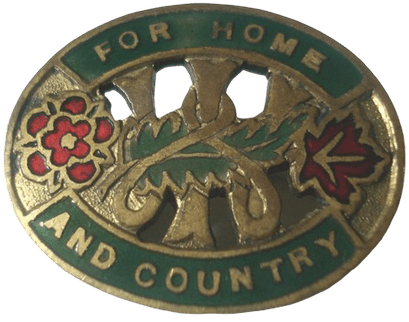
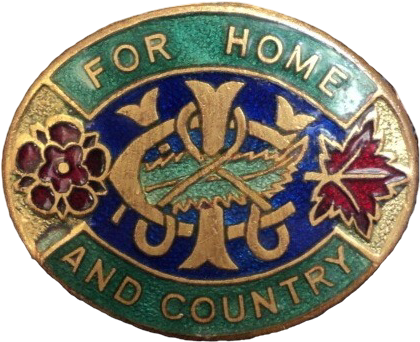
Left: Women’s Institute membership badge prior to 1952 name change. Right: Country Women’s Institute membership badge after name change.
As in most other parts on the country, Women’s Institutes were established on Waiheke, and, between the 1942 and 1998, at least five existed on the Island. Oneroa, Onetangi, Putiki Bay, Rocky Bay and Surfdale. The first to be established was at Surfdale in 1942. This was followed by Oneroa in 1948 and the other three were established during the early 1950s. In the 1970s the Surfdale and Oneroa institute would combine.
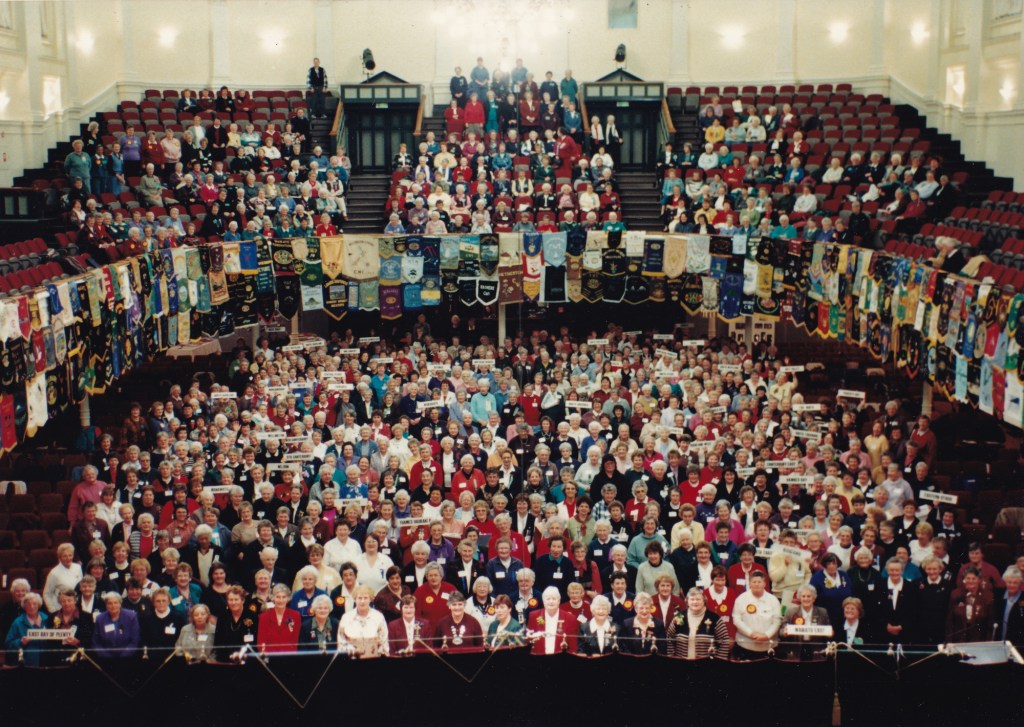
At some stage early on, individual institutes began designing and making their own banners. Exactly when this started is unknown, at lest to this writer. However, given the range of skills involved in making a banner, it is not difficult to understand the appeal of such an undertaking in an organization dedicated to promoting crafts for women. By the 1930s most institutes had their own a banner, all representing in their own ways the district in which each institute was located. Newly formed institutes would make creating a banner somewhat of a priority. The author of the 60th Anniversary Book published by the Federation of new Zealand Country Women’s Institutes in 1982 to observe:
“When I attended Conference for the first time … I was fascinated with all the Institute banners arranged right around the Wellington Town Hall“3
The following photo, taken at the annual conference of the Federation of Country Women’s Institutes in Wellington in 1998, nicely illustrates the cause of her “fascination.”
Like all others around the country, Waiheke’s institutes each had their own unique banner. The Museum of Waiheke has in its collection banners of each of the institutes listed above, apart from Rocky Bay.
The first to be made was undoubtedly Surfdale’s but when this was and who were the individuals involved is not known for certain. But it is likely it was sometime around the end of World War II and the year 1944 is embroidered on the banner. Oneroa’s banner followed soon after its foundation in 1948. Onetangi’s and Putiki Bays’ banners followed in the early 1950s and when, around 1978, the Surfdale and Oneroa institutes merged, a new Surfdale & Oneroa banner was created.
To see each Waiheke institute’s banner and to read more about each, click on the names below
Surfdale
Oneroa
Onetangi
Putiki Bay
Surfdale & Oneroa
EXPLORE THE BANNERS OF OTHER COUNTRY WOMEN’S INSTITUTES AROUND NEW ZEALAND
- Harper, Barbara, The history of the Country Women’s Institutes in New Zealand 1921–1958, Whitcombe & Tombs, Christchurch, 1960 ↩︎
- For a fuller account of the New Zealand federation of Country Women’s Institutes see Rosemarie Smith’s New Zealand Federation of Country Women’s Institutes at https://nzhistory.govt.nz/women-together/new-zealand-federation-womens-institutes ↩︎
- Mills, Marion, New Zealand Country Women’s Institutes 60th Anniversary Book (1921 – 1981). Federation of New Zealand Country Women’s Institutes, 1982 ↩︎
 Museum of Waiheke